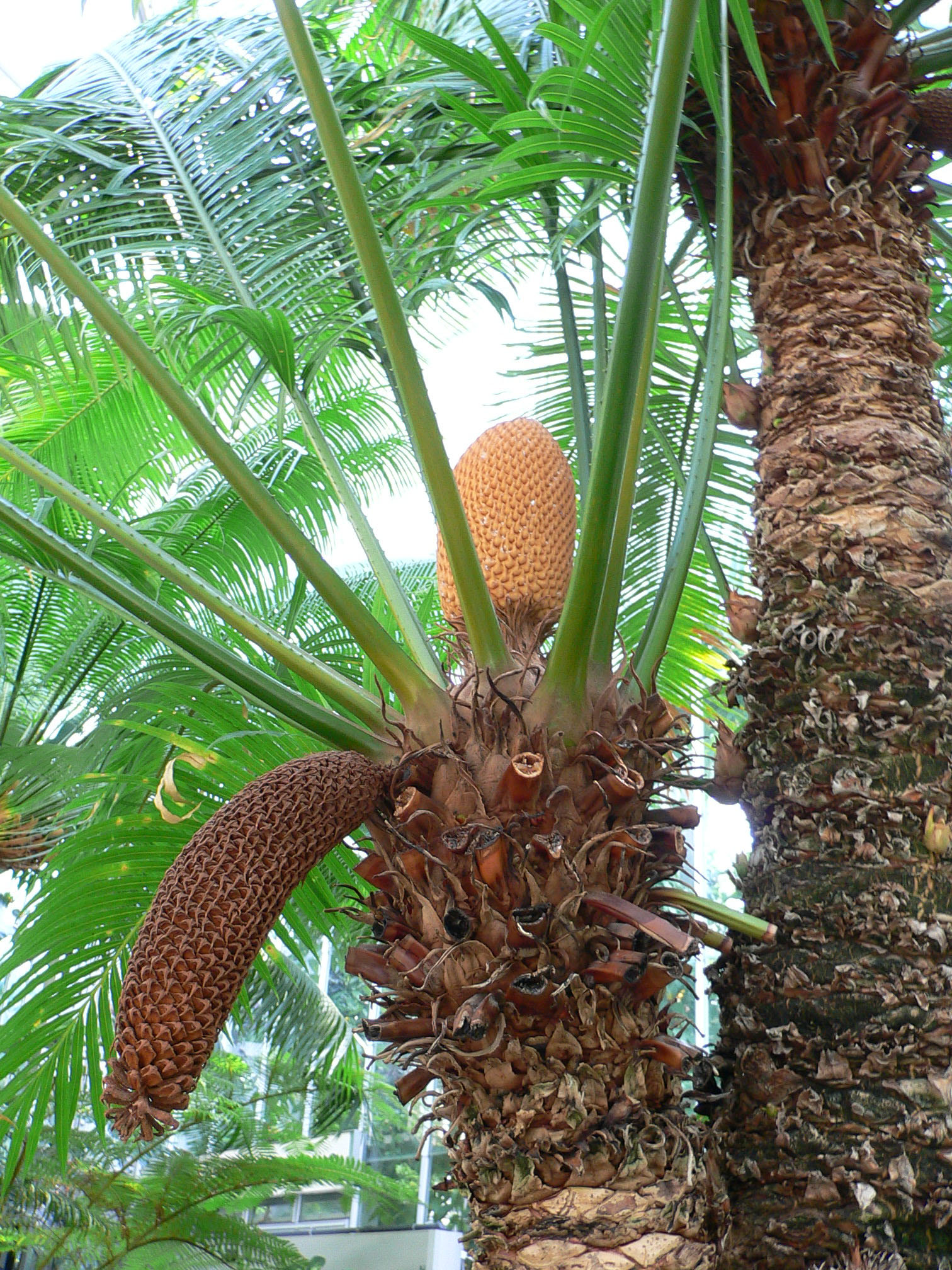

External features of Cycas:
Cycas plant is a well developed tree. It grows in xeric habitat and is a slow growing plant reaching a height of 3-5 metres in about 100 years. It has true root, stem and leaves.
Root: It has a tap root system. The roots are well branched and fix the plant firmly into the soil. However, some branches of secondary roots are apogeotropic, come out of the soil. They become associated with some blue green algae like Nostoc and Anabaena. They are repeatedly branched like corals and are called coralloid roots.
Stem: Stem is stout and remain underground for many years. When aerial, it is unbranched and is armoured with thick persistent leaf bases. Leaves occur as a crown in the apical part. Male plant has two types of leaf bases: Foliage leaf bases and the scale leaf bases. Female plants have three types of leaf bases i.e., foliage leaf bases, megasporophyll bases and the scale leaf bases, Bulbils appear in the lower part of stem in Cycas revoluta. They serve as means of vegetative propagation.
Leaves: Leaves are of two types, (dimorphic). The foliage leaves and the scale leaves.
Foliage leaves are large pinnately compound having 50-100 pairs of leaflets arranged on a rachis. The leaflets are seesile and have a single unbranched midrib. The leaflets are hard and coriaceous. In Cycas revolute, the margins are folded down ward. The leaflets and the rachis show circinate ptyxis in the bud condition. Scale leaves occur alternating with the foliage leaves. They are brown, hard persistent and non photosynthetic.