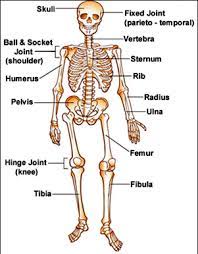

Anatomy of Human bones:
INTRODUCTION:
As a person ages, some bones fuse, a process which typically lasts until sometime within the third decade of life. Therefore, the number of bones in an individual may be evaluated differently throughout a lifetime. In addition, the bones of the skull and face are counted as separate bones, despite being fused naturally. Some reliable sesamoid bones such as the pisiform are counted, while others, such as the hallux sesamoids, are not.
Individuals may have more or fewer bones than the average (even accounting for developmental stage) owing to anatomical variations. Some individuals may also have additional (i.e., supernumerary) cervical ribs or lumbar vertebrae. Amputations or other injuries may result in the loss of bones. Complete bone fractures may split one bone into multiple pieces.
BONES:
The axial skeleton, comprising the spine, chest and head, contains 80 bones. The appendicular skeleton, comprising the arms and legs, including the shoulder and pelvic girdles, contains 126 bones, bringing the total for the entire skeleton to 206 bones. Infants are born with about 300 bones with most of it being cartilage, but will later fuse together and decrease over time to 206 bones.
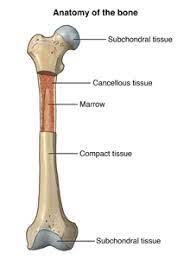
Bone is living tissue that makes up the body’s skeleton. There are 3 types of bone tissue, including the following:
1. Anatomy of a bone, showing the subchondral tissue, marrow, cancellous tissue, and compact tissue.
2. Compact tissue. The harder, outer tissue of bones.
3.Cancellous tissue. The sponge-like tissue inside bones.
Subchondral tissue. The smooth tissue at the ends of bones, which is covered with another type of tissue called cartilage. Cartilage is the specialized, gristly connective tissue that is present in adults. It is also the tissue from which most bones develop in children.
What are the functions of bone?
Bone provides shape and support for the body, as well as protection for some organs. Bone also serves as a storage site for minerals and provides the medium—marrow—for the development and storage of blood cells.
The different types of bone cells include the following:
1.Osteoblast. Found within the bone, its function is to form new bone tissue.
2.Osteoclast. A very large cell formed in bone marrow, its function is to absorb and remove unwanted tissue.
3.Osteocyte. Found within the bone, its function is to help maintain bone as living tissue.
4.Hematopoietic. Found in bone marrow, its function is to produce red blood cells, white blood cells, and platelets.