
What is Protein:
Proteins are complex nitrogenous organic bio-polymers of amino acids showing greatdiversity in their organization and are of prime biological importance.
What foods are high in protein?
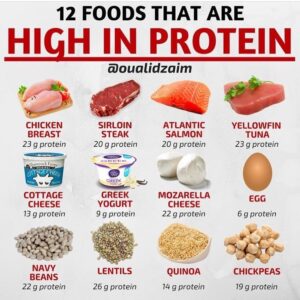
Protein can be found in both plant and animal-based foods. Figure 2 shows the protein content found in a typical serving of common animal and plant-based foods. For more information on how to estimate healthy portion sizes, see measuring portion sizes with your hands.

What are the health benefits of protein?
Eating enough protein to meet our bodies’ requirements is important for many body functions. However, there is evidence to suggest that in certain situations increasing protein intake above required levels could provide additional health benefits.
1. Protein and Weight Control
Eating protein-rich foods has been shown to increase our feeling of fullness (also known as satiety) more than foods high in fat or carbohydrate. There is good evidence from short term studies that diets high in protein (i.e. 1.2 – 1.6 g/kg per day; 84 – 112 g per day for a 70 kg adult) can help reduce overall calorie intake and prompt weight loss. 5 However, the evidence for long-term weight maintenance is less clear.5 Like all diets, a high protein diet is only effective if it is stuck to, which can be difficult for some people and low adherence may partly explain the limited benefit observed for long term weight maintenance.5
2. Protein and sarcopenia
Sarcopenia is a disorder characterised by the progressive loss of muscle mass and physical function that is commonly associated with older adults. Sarcopenia is associated with increased frailty, risk of falls, functional decline and even early death.6 As protein is essential for the repair and maintenance of muscle mass, it is no surprise that low intake of protein is associated with an increased risk of developing sarcopenia.6 Similarly, increasing protein intake, as well as increasing physical activity can help maintain muscle mass and strength as we age, decreasing our risk of sarcopenia and skeletal disorders.
3. Protein and athletic performance
Protein has long been associated with athletic performance. Protein plays a key role in helping to repair and strengthen muscle tissue after exercise. Although protein is critical for building muscle, to maximise the benefits it should be considered in the context of the whole diet, which includes the right amount of carbohydrates, fats, vitamins and minerals.
General structure and properties of proteins:
The amino acid composition of proteins
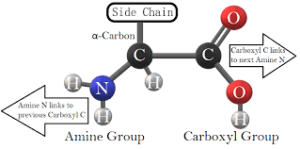
The common property of all proteins is that they consist of long chains of α-amino (alpha amino) acids. The general structure of α-amino acids is shown in . The α-amino acids are so called because the α-carbon atom in the molecule carries an amino group (―NH2); the α-carbon atom also carries a carboxyl group (―COOH).
Proteins. Formula 1: Generalized structure of all a-amino acids.
Although more than 100 amino acids occur in nature, particularly in plants, only 20 types are commonly found in most proteins. In protein molecules the α-amino acids are linked to each other by peptide bonds between the amino group of one amino acid and the carboxyl group of its neighbour.
Classification of Proteins:
Based on the molecular shape, proteins can be classified into two types.
1. Fibrous Proteins:
When the polypeptide chains run parallel and are held together by hydrogen and disulfide bonds, then the fiber-like structure is formed. Such proteins are generally insoluble in water. These are water-insoluble proteins.
Example – keratin (present in hair, wool, and silk) and myosin (present in muscles), etc.
2. Globular Proteins:
This structure results when the chains of polypeptides coil around to give a spherical shape. These are usually soluble in water.
Example – Insulin and albumins are common examples of globular proteins.
Levels of Protein Structure:
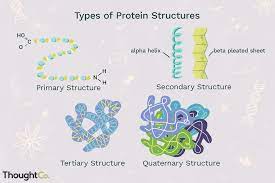
1. Primary Structure of Protein
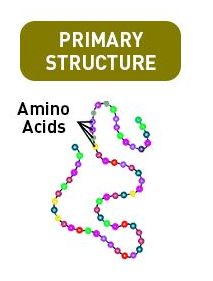
The Primary structure of proteins is the exact ordering of amino acids forming their chains.
The exact sequence of the proteins is very important as it determines the final fold and therefore the function of the protein.
The number of polypeptide chains together form proteins. These chains have amino acids arranged in a particular sequence which is characteristic of the specific protein. Any change in the sequence changes the entire protein.
2. Secondary Structure of Protein
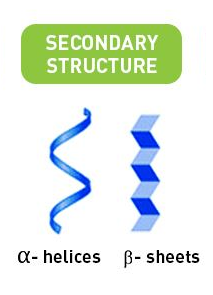
Secondary structure of protein refers to local folded structures that form within a polypeptide due to interactions between atoms of the backbone.
The proteins do not exist in just simple chains of polypeptides.
These polypeptide chains usually fold due to the interaction between the amine and carboxyl group of the peptide link.
The structure refers to the shape in which a long polypeptide chain can exist.
They are found to exist in two different types of structures α – helix and β – pleated sheet structures.
This structure arises due to the regular folding of the backbone of the polypeptide chain due to hydrogen bonding between -CO group and -NH groups of the peptide bond.
However, segments of the protein chain may acquire their own local fold, which is much simpler and usually takes the shape of a spiral an extended shape or a loop. These local folds are termed secondary elements and form the proteins secondary structure.
3. Tertiary Structure of Protein
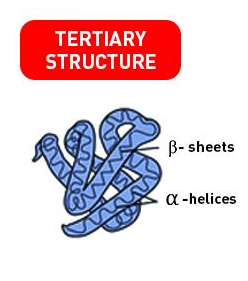
This structure arises from further folding of the secondary structure of the protein.
H-bonds, electrostatic forces, disulphide linkages, and Vander Waals forces stabilize this structure.
The tertiary structure of proteins represents overall folding of the polypeptide chains, further folding of the secondary structure.
It gives rise to two major molecular shapes called fibrous and globular.
The main forces which stabilize the secondary and tertiary structures of proteins are hydrogen bonds, disulphide linkages, van der Waals and electrostatic forces of attraction.
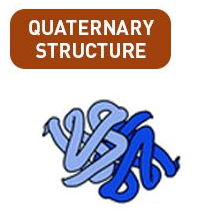
4. Quaternary Structure of Protein
The spatial arrangement of various tertiary structures gives rise to the quaternary structure. Some of the proteins are composed of two or more polypeptide chains referred to as sub-units. The spatial arrangement of these subunits with respect to each other is known as quaternary structure.