
Blood group:
INTRODUCTION: The term “blood group” refers to the entire blood group system comprising red blood cell (RBC) antigens whose specificity is controlled by a series of genes which can be allelic or linked very closely on the same chromosome. “Blood type” refers to a specific pattern of reaction to testing antisera within a given system. Over a period of time, our understanding on blood groups has evolved to encompass not only transfusion-related problems but also specific disease association with RBC surface antigens. Karl Landsteiner has been credited for the discovery of ABO blood group system in 1900.
ABO system
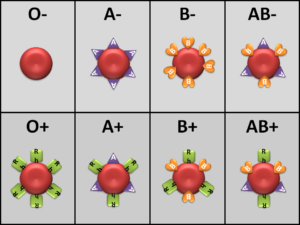
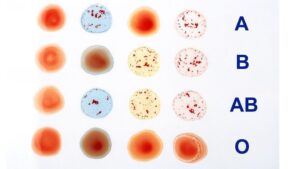
Among the 33 systems, ABO remains the most important in transfusion and transplantation since any person above the age of 6 months possess clinically significant anti-A and/or anti-B antibodies in their serum. Blood group A contains antibody against blood group B in serum and vice-versa, while blood group O contains no A/B antigen but both their antibodies in serum.
H-antigen
H-antigen is the precursor to the ABO blood group antigens. It is present in all RBCs irrespective of the ABO system. Persons with the rare Bombay phenotype are homozygous for the H gene (HH), do not express H-antigen on their RBCs. As H-antigen acts as precursor, its absence means the absence of antigen A and B. However, the individuals produce isoantibodies to H-antigen as well as to antigens A and B.
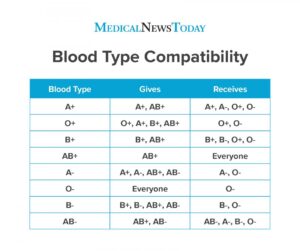
There are 4 main blood groups (types of blood) – A, B, AB and O. Your blood group is determined by the genes you inherit from your parents. Each group can be either RhD positive or RhD negative, which means in total there are 8 blood groups.
Rhesus system
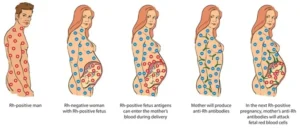
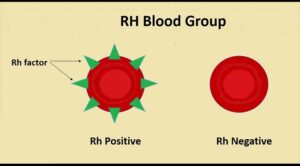
Rhesus-system is the second most important blood group system after ABO.[4] Currently, the Rh-system consists of 50 defined blood group antigens out of which only five are important. RBC surface of an individual may or may not have a Rh factor or immunogenic D-antigen. Accordingly, the status is indicated as either Rh-positive (D-antigen present) or Rh-negative (D-antigen absent). In contrast to the ABO system, anti-Rh antibodies are, normally, not present in the blood of individuals with D-negative RBCs, unless the circulatory system of these individuals has been exposed to D-positive RBCs. These immune antibodies are immunoglobulin G (IgG) in nature and hence, can cross the placenta. Prophylaxis is given against Rh immunization using anti-D Ig for pregnant Rh-negative mothers who have given birth to Rh-positive child.