

Examples of Phylum Protozoa
1. Ameoba Proteus:
Classification:
- Phylum: Amoebozoa
- Class: Tubulinea
- Order: Tubulinea
- Family: Amoebidae
- Genus/Scientific Name: Amoeba Proteus
Habitat :- It is a cosmopolitan, unicellular, fresh and salt water, wet soil and animals. Amoeba proteus is widely distributed and commonly found on the bottom mud or on the underside of aquatic vegetation in freshwater, ponds. It is commonly called little Proteus.
Habits :
- Locomotion: It shows amoeboid locomotion with the help of many lobopodia.
- Feeding: It is omnivorous and holozoic in its nutrition. It feeds on bacteria, diatoms,ciliates etc. Digestion is intracellular.
- Reproduction: It undergoes only asexual reproduction and occurs by binary fission during favorable conditions and by multiple fission in both encysted and unencysted sporulation forms.
Morphology:
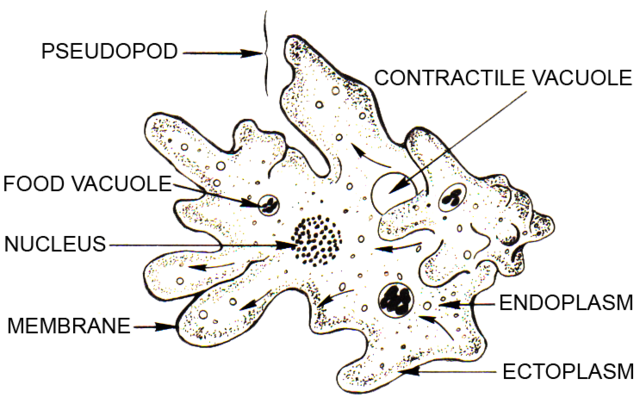
- Irregular shaped body due to presence of many lobopodia.
- Cytoplasm is differentiated into ectoplasm and endoplasm.
- Endoplasm is differentiated into plasmagel and plasmasol.
2. Euglena:
Classification:
- Phylum: Euglenozoa
- Class: Euglenoideae
- Order: Euglenida
- Genus/Scientific Name: Euglena
Habitat :- It is a fresh water, solitary,free swimming,asellular and flagellate protozoans found in stagnant water containing nitrogenous wastes. It is commonly called plant animal.
Habits :
- Locomotion: It shows flagellar or swimming type locomotion in water with the help of undulatory movements of flagellum.
- Feeding: Green species of Euglena are autotropic or holotropic while non green species are saprozoic.
- Reproduction: It reproduces only asexually by longitudinal binary fission. It does not undergo sexual reproduction.
Morphology:
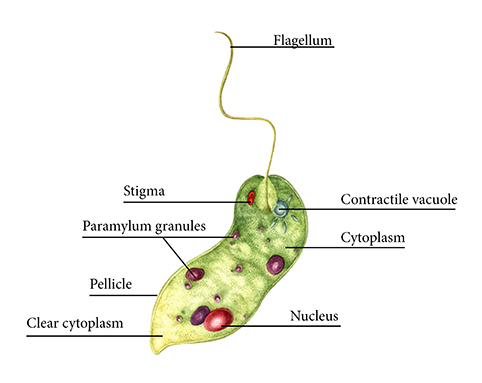
- Spindle shaped body and covered by a difinite pellicle.
- Cytoplasm is differentiated into ectoplasm and endoplasm.
- Endoplasm has a vesicular nucleus, radially arranged chloroplasts and many paramylum bodies.
3. Paramecium caudatum:
Classification:
- Phylum: Ciliophora
- Class:Oligohymenophorea
- Order: Peniculida
- Genus/Scientific Name: Paramecium caudatum
Habitat :- It is a fresh-water, free-living, cosmopolitan, acellular and ciliate protozoan found in water bodies containing large number of bacteria and decaying vegetation. It is commonly called slipper animalcule.
Habits :
- Locomotion: It shows swimming in water and creeping on substratum both with the help of cilia
- Feeding: It is omnivorous and holozoic. It is a filter feeder of bacteria, algae, protozoans, organic particulate matter, etc. Digestion is intracellular.
- Reproduction: It undergoes asexual reproduction by transverse binary fission and sexual reproduction by conjugation or autogamy or endomixis.
Morphology:
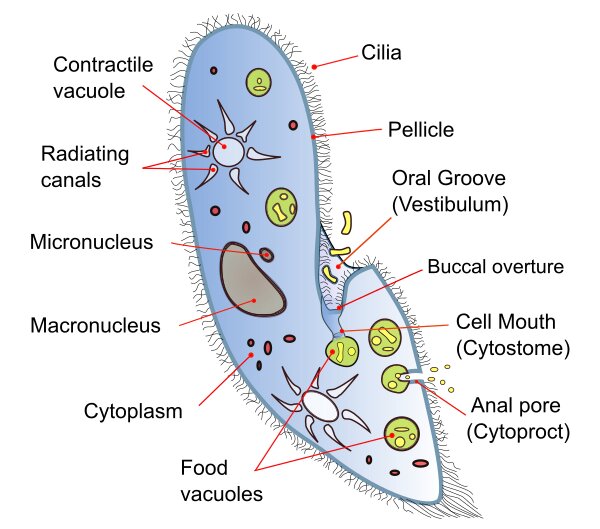
- Slipper-shaped body covered by a definite pellicle.
- Body is uniformly covered by cilia arranged in longitudinal rows.
- Cytoplasm is differentiated into ectoplasm and endoplasm.