
What is Lipids:
Introduction of Lipids:
Bloor (1943) defined the lipids as – “Lipids are naturally occurring heterogeneous organic compounds which are insoluble in water but soluble in fat solvents; and on hydrolysis yield fatty acids which are utilized by the living organisms.” because water is pelar molecule
CHEMICAL COMPOSITION (and is the)
Lipids constitute about 3.5% of the cellular pool. The lipids, especially the neutral fats (trigly
cerides), are chemically formed of carbon, hydrogen and oxygen as in the carbohydrates. But the
number of oxygen atoms is less than carbon atoms. So fats are not easily oxidizable. Some fats havnitrogen or phosphorus.
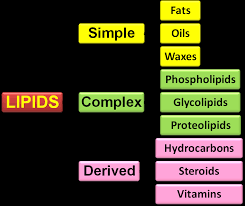
Classification of lipids: There are two major types of lipids- simple lipids and complex lipids. Simple lipids are esters of fatty acids with various alcohols. For eg., fats and waxes. On the contrary, complex lipids are esters of fatty acids with groups other than alcohol and fatty acids.
What are the main types of lipids?
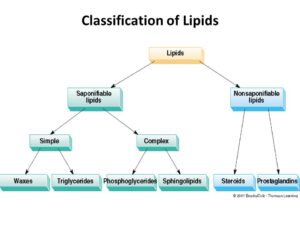
There are two major types of lipids- simple lipids and complex lipids. Simple lipids are esters of fatty acids with various alcohols. For eg., fats and waxes. On the contrary, complex lipids are esters of fatty acids with groups other than alcohol and fatty acids. For eg., phospholipids and sphingolipids.
1.What are Simple Lipids?
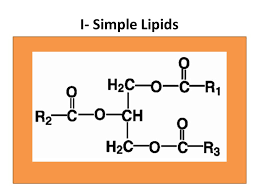
Simple lipids are esters of fatty acids and glycerols or alcohols. They do not carry other substances, unlike complex lipids. There are two types of simple lipids as fats/oils and waxes.
Fats or oils are esters of fatty acids with glycerols while waxes are esters of fatty acids with alcohols. They are a heterogeneous group of nonpolar compounds. They are soluble only in nonpolar organic solvents such as chloroform and benzene.
2.What are Complex Lipids?
Complex lipids or compound lipids are another group of lipids composed of fatty acids, alcohols and other groups such as phosphate, nitrogenous bases, proteins, carbohydrates, etc. Based on the group present in the complex lipid, they are different types as phospholipids, glycolipids, lipoproteins, sulfolipids, aminolipids, lipopolysaccharides, etc.
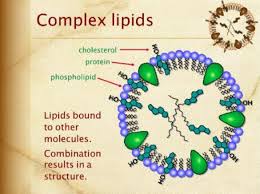
Phospholipids contain fatty acids, alcohols, and phosphoric acid. Glycerophospholipids and Phosphosphingolipids are two types of phospholipids. Glycolipids contain carbohydrates while lipoproteins contain proteins as the other molecules. LDL and HDL are two types of lipoproteins while glycosphingolipids are a type of glycolipids.
3. Derived lipids: When both simple and compound lipids combine and undergo the process of hydrolysis, the produced chemical is known as the derived lipids. Derived lipids include cholesterol, carotenes, steroids and prostaglandins etc.. They are derivatives of lipid or lipid-like substances like- fatty acids that can originate from the simple and compound lipids by means of hydrolysis. Cholesterol, bile acids, and sex and adrenocortical hormones are examples.