
What is Herdmania?
SYSTEMATIC POSITION
Phylum: Chordata
Class: Ascidicea
Order: Pleurogona
Genus: Herdmania
Introduction of Herdmania:
Herdmania is a simple ascidian. It is popularly called as sea squirt or sea potato. There are about 12 species of Herdmania. Out of that only 4 species are present in Indian Ocean: H. pallida, H. enmurensis, H. ceylonica and H. mauritiana. H. pallida is described here.
Habits and Habitat:
It is exclusively marine and inhabits shallow water along the Indian sea coast. It is sedentary ascidian attached to the rocky substratum by broad flat base or embedded in sandy floor by foot. Sometimes it is attached to the shell of a living gastropod like Xanchus. The mollusc carries it place to place, providing it more food and oxygen. The gastropod protected by it. So this is an example of protocooperation. Herdmania is often gregarious, generally 10 to 12 individuals are attached in a group at one place. Herdmania is a ciliary feeder. It is hermaphrodite, fertilization is external. Its development is indirect. There is present a free swimming tailed larva called tadpole. It retrogressive metamor phosis to become the sessile adult.
External characters:
- Shape, size and colour. It looks like a purse or potato. Its body is compressed laterally and is oblong or rectangular in shape with narrower attached end. It varies from 7-10 cm in length and 4-7 cm broad and 4-6 cm long. It is pinkish in natural conditions but turns yellowish brown on preservation.
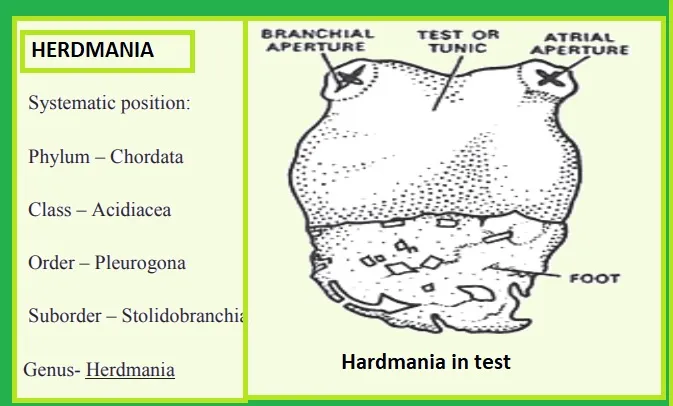
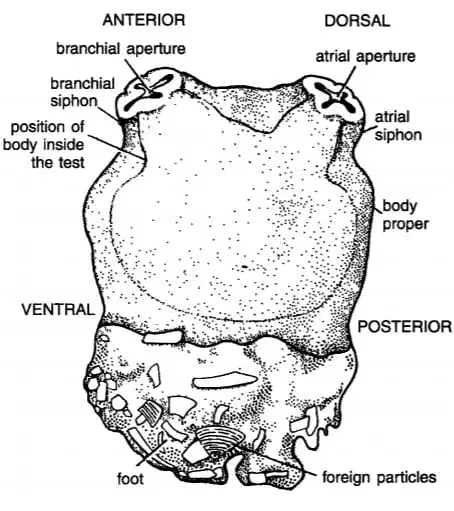
II. Body. The body is divided into two parts: Body proper and foot (Fig. 1). The body is covered by the test.
(A) Body proper. The upper free part of body is called body proper. At upper free end of the body proper, two cylindrical projections I called branchial and atrial siphons are present.
The branchial siphon or oral siphon is smaller and has an opening at tip called as branchial aperture or mouth. The atrial siphon is longer and bearing a terminal opening called atrial aperture, Both the apertures are guarded by four distinct lobes called lips. The body is broader and longer than foot.
(B) Foot. The base or foot is dirty and rough due to attachment of sand and other foreign
particles. Its shape and size varies according to substratum. On a sandy surface, a long foot is present
whereas on hard surface a flat concave base is present.
III. Orientation. The branchial aperture represents anterior side, the opposite side attached to substratum is called posterior side. The atrial aperture represents dorsal side, the opposite side is called ventral side. This peculiar orientation is result of rotatory changes, occurring during metamor- phosis.
Test or Tunic:
The body of Herdmania is covered by test or tunic. It is thick, leathery and translucent. It is secreted by epidermis of the body wall and wears off continuously from outer surface. It consists of (Fig. 2A): (A) clear gelatinous matrix (B) corpuscles of various types
(C) interlacing fibrils (D) blood vessels and (E) calcareous spicules.
(A) Matrix. It is made up of tunicine (a polysaccharide). (B) Corpuscles In the matrix, the cells derived from mesoderm are embedded.
Mantle or Body wall:
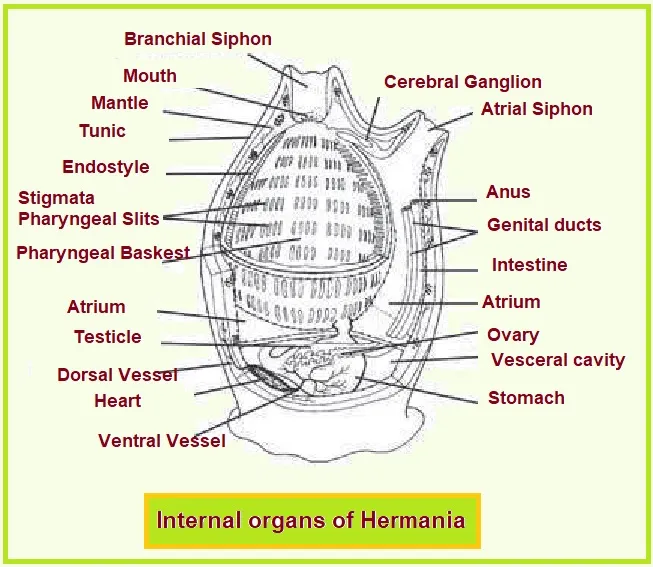
Body wall or mantle lies below the test. It secretes the test. It encloses a large cavity called atrium. The mantle is attached to test only at branchial and atrial aperture. It is not uniformly developed around body. It is thick, highly muscular and opaque on anterodorsal side. It is thin, transparent and almost without muscles on posteroventral side.
The mantle is formed of three layers: outer epidermis, middle mesenchyme and inner
epidermis.
(i) Outer epidermis. It is made up of single layer of flat, hexagonal ectodermal cells. At
branchial and atrial apertures it turns over to reach upto the base of the siphons. It secretes test.
(ii) Middle Mesenchyme. It lies below outer epidermis. It consists of connective tissue fibres,
nerve fibres, muscle fibres and blood sinuses. The smooth muscle fibres are of three types: annular muscles, longitudinal muscles and branchioatrial muscles. Annular muscles surround the siphons as rings. The longitudinal muscles lie below annular muscles and radiate from atrial and branchial apertures upto the middle of body. The branchioatrial muscles extend deeper between siphons. (iii) Inner epidermis. It lines atrium and is formed of single layer of hexagonal cells.