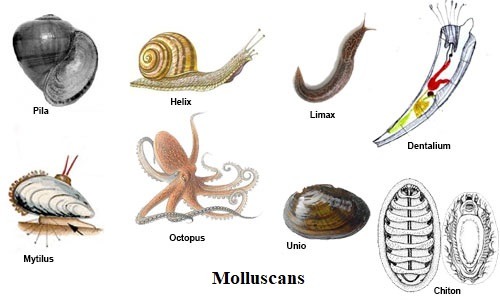

General Characters of phylum Mollusca:
- Habitat: Most of molluscs are aquatic and marine e.g. Mytilus, Sepia, Octopus etc. while a few are fresh-water (e.g. Unio) or terrestrial (e.g. Limax). Pila is an amphibious mollusc while Stylifer, Thyca and Entochoncha are parasitic gastropod molluscs.
- It is the largest marine phylum and forms about 23% of all the marine organisms.
- Organisation. These have organ-system organisation.
- Symmetry. Most of these are bilateral symmetrical while the snails like Pila, Heliotis etc.
- Germ layers. These are triploblastic animals without any exception.
- Coelom. Molluscs are true coelomate and schizocoelomates but true coelom is reduced as pericardial cavity , gonocoels and urocoels.
- Body division. Body is usually unsegmented and is divided into three parts: ventral sole-like foot (for locomotion), head (with sense organs and nervous system) and visceral mass of digestive, circulatory, reproductive organs, etc.).
- Head is absent in the pelecypods and scaphopods.
- The head is complex and well developed in the cephalopo.
- 7.Body wall. It is formed of single layered epidermis and distinct bands or sheets of smooth unstriped muscles in dermis.
8. Shell. In most of molluscs, mantle secretes a calcareous shell. Shell may be formed of one (e.g. Neopilina) or two (e.g. Pelecypods like Unio) or many pieces (e.g. 8 pieces in Chiton).
9. Digestive system. Gut is long, coiled and complete. These usually have a rasping and, it becomes U-shaped as anus is also anterior in position. Digestive gland is hepatopancreas (functions as pancreas, liver and intestine as is digestive, storage and absorptive in function)
10. Circulatory system. It is usually of open or lacunar type except the cephalopods (e.g Sepia, Loligo) which have closed circulatory system. Heart is dorsal and is formed of 1 or 2 auricles and one ventricle. lies in a true coelomic compartment called pericardium.
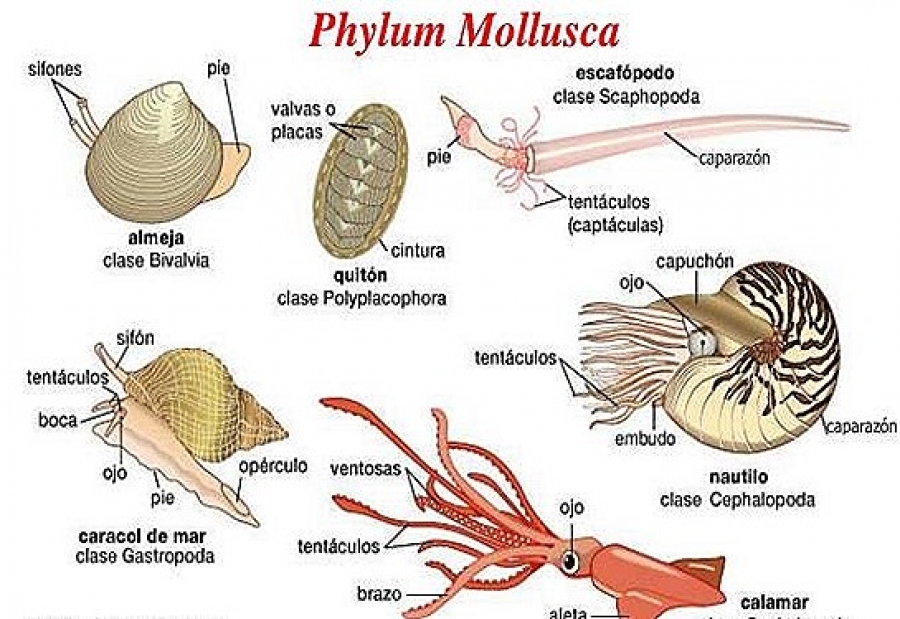
Examples of Mollusca